There is no single best way to heat a Minnesota home — it depends on where you live, what infrastructure reaches you, and what equipment you already have. Here's how the main options really compare in a cold climate.
Natural gas: cheap where it reaches
Where a natural-gas main runs down the street, gas is often the least expensive fuel per unit of heat and the most convenient — it arrives by pipeline, so there is no tank to fill and no delivery to schedule. That makes it the default in cities and denser suburbs.
The catch is availability. Natural gas mains do not extend to most rural properties, and running a new line to a distant home is rarely practical. For a large share of the Upper Midwest — farms, lake homes, and country properties — natural gas simply is not an option, which is precisely where oil and propane come in.
Heating oil: high output, on-site reserve
Heating oil packs more energy per gallon than propane — roughly 138,000 BTUs versus about 91,000 — so a tank of oil represents a large store of heat. Oil-fired systems produce strong, fast heat that recovers a chilled house quickly, a real advantage during deep cold.
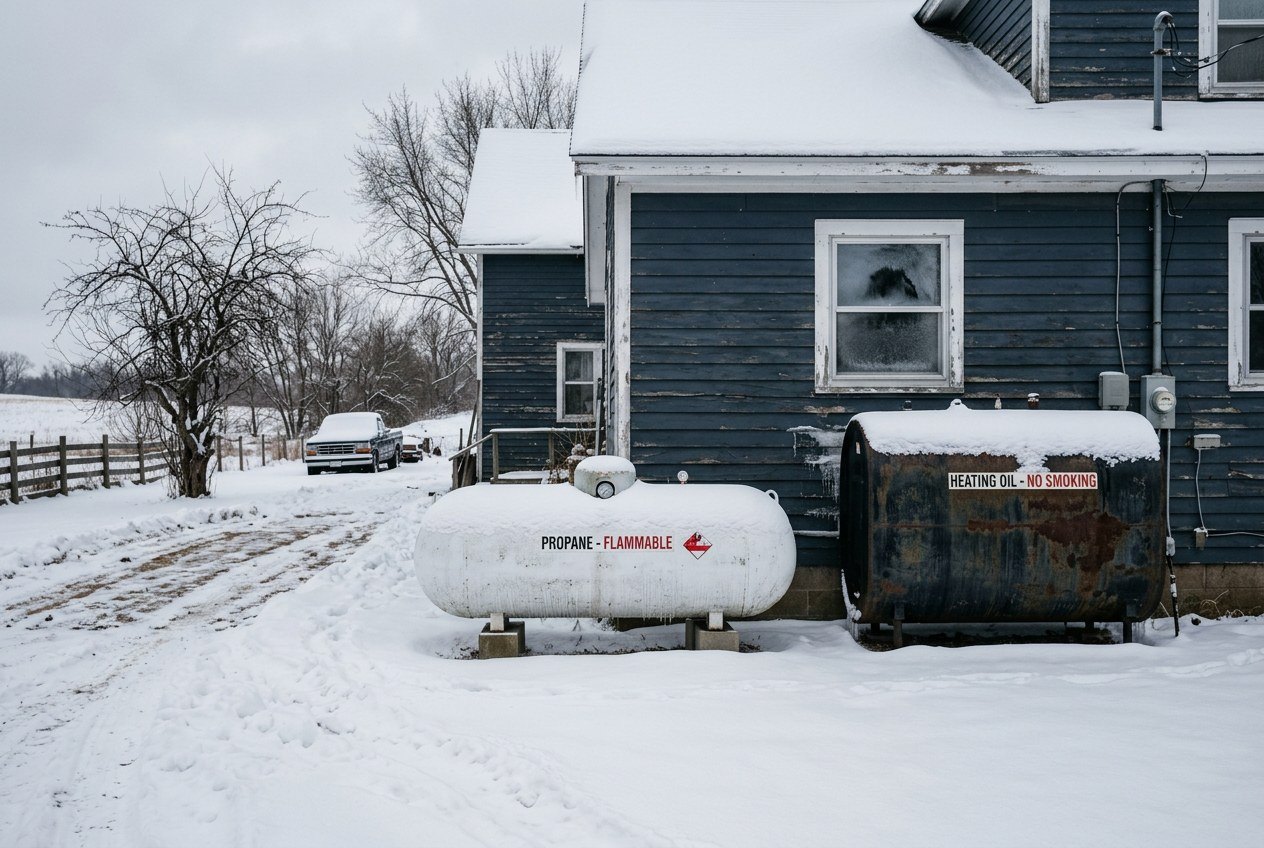
Oil's strengths are its energy density, its safe on-site storage, and equipment that thrives in harsh winters. Its considerations are that prices track the broader oil market and can move seasonally, and that the system requires an annual tune-up and periodic tank attention. For rural homes off the gas grid, oil remains a proven, capable choice.
Propane: clean and flexible, less dense
Propane is another tank-delivered fuel widely used beyond the gas mains. It burns very cleanly, works for heating as well as cooking, water heating, and appliances, and stores as a pressurized liquid in a tank that is often leased. Propane appliances tend to be compact and efficient.
Because propane holds fewer BTUs per gallon than oil, a home will generally burn more gallons of propane to produce the same heat, so a straight price-per-gallon comparison can mislead — what matters is cost per unit of delivered heat. Propane's clean burn and versatility make it popular; its lower energy density is the main trade-off against oil.

Compare fuels by cost per BTU or per unit of delivered heat, not by price per gallon — a gallon of oil and a gallon of propane do not carry the same amount of energy.
Cold-climate heat pumps: dual-fuel, not a full replacement
Electric heat pumps have improved dramatically, and cold-climate models now pull useful heat from outdoor air even when temperatures fall well below freezing. In much of the country they can carry a home on their own. In Minnesota, though, the reality is more nuanced.
During the harshest stretches — the deep sub-zero days that define an Upper Midwest winter — a heat pump's output and efficiency decline just as heating demand peaks. For that reason, cold-climate heat pumps in Minnesota are usually installed as part of a dual-fuel system: the heat pump handles milder weather efficiently, and an oil, propane, or gas furnace automatically takes over when it gets truly cold. Rather than replacing a fuel-fired system, a heat pump often complements one, trimming fuel use across the shoulder seasons while the furnace guarantees warmth on the coldest nights.
How to think about your own home
- Is a gas main available? If yes, gas is usually the cheapest option. If not, the real choice is between oil and propane.
- What equipment do you already have? A sound oil furnace or boiler represents a substantial investment; keeping and maintaining it is often more sensible than switching fuels.
- How cold does it get, and for how long? Sustained deep cold favors high-output, energy-dense fuel and reliable on-site storage.
- Are you considering a heat pump? In Minnesota, plan for a dual-fuel setup rather than expecting a heat pump to stand alone.
It's also worth remembering that switching fuels is rarely cheap. Changing from oil to another system means new equipment and, in the case of a heat pump, electrical upgrades — costs that can take many years of fuel savings to recoup, if they ever do. For a household with a sound, well-maintained oil furnace or boiler already in place, the most economical path is very often to keep it running well rather than to replace it chasing a marginally cheaper fuel. The right answer genuinely depends on your specific home, your existing equipment, and what infrastructure reaches your property.
Whatever you choose, the fundamentals of running an oil system well are covered across this site. Start with heating oil basics, protect your fuel with good tank care, ready the house with winter prep, and understand refills through delivery and supply.