Unlike pipeline fuels, heating oil is delivered by truck and stored on your property, which means a little planning keeps you comfortably ahead of demand. Here's how home fuel supply generally works.
Your tank is your reserve
The defining feature of oil heat is that your fuel lives on-site. A residential tank holds a substantial supply — often enough for weeks of cold weather — so your job as a homeowner is simply to make sure it never runs too low. A delivery truck refills the tank through a fill pipe, and the fuel then sits ready until your system draws on it. This on-site reserve is a genuine advantage in a rural, cold-climate region: your heat does not depend on a pipeline staying pressurized during a storm.
Two ways to schedule fuel
Broadly, households manage their oil supply in one of two ways.
Will-call (on-demand) delivery
With will-call, you monitor your own tank and request a delivery when the level gets low. This gives you full control and works well for attentive homeowners who check the gauge regularly. The risk is human: forget to look during a busy stretch, and you can run the tank dry — which is not only inconvenient but can pull sludge and air into the fuel lines. Anyone on will-call should build a habit of checking the gauge often and ordering well before the tank nears empty.
Automatic delivery
With automatic delivery, deliveries are scheduled for you based on an estimate of how fast your home uses fuel, so the tank is topped up before it runs low without you having to track it. Many homeowners prefer this for the peace of mind, especially during winter when travel is difficult and demand is high.
How automatic delivery estimates your usage
The clever part of automatic delivery is degree-day monitoring. A "heating degree day" is a simple measure of how cold a day was relative to a baseline indoor temperature — the colder the day, the more degree days it accumulates, and the more heat a home needs. By combining a home's known fuel-use rate with local degree-day data, a supplier can estimate how much oil the household has burned since the last fill and predict when the tank will approach a set minimum. Deliveries are then timed to arrive before that point. It is a well-established method that works without anyone climbing into the basement to read the gauge.
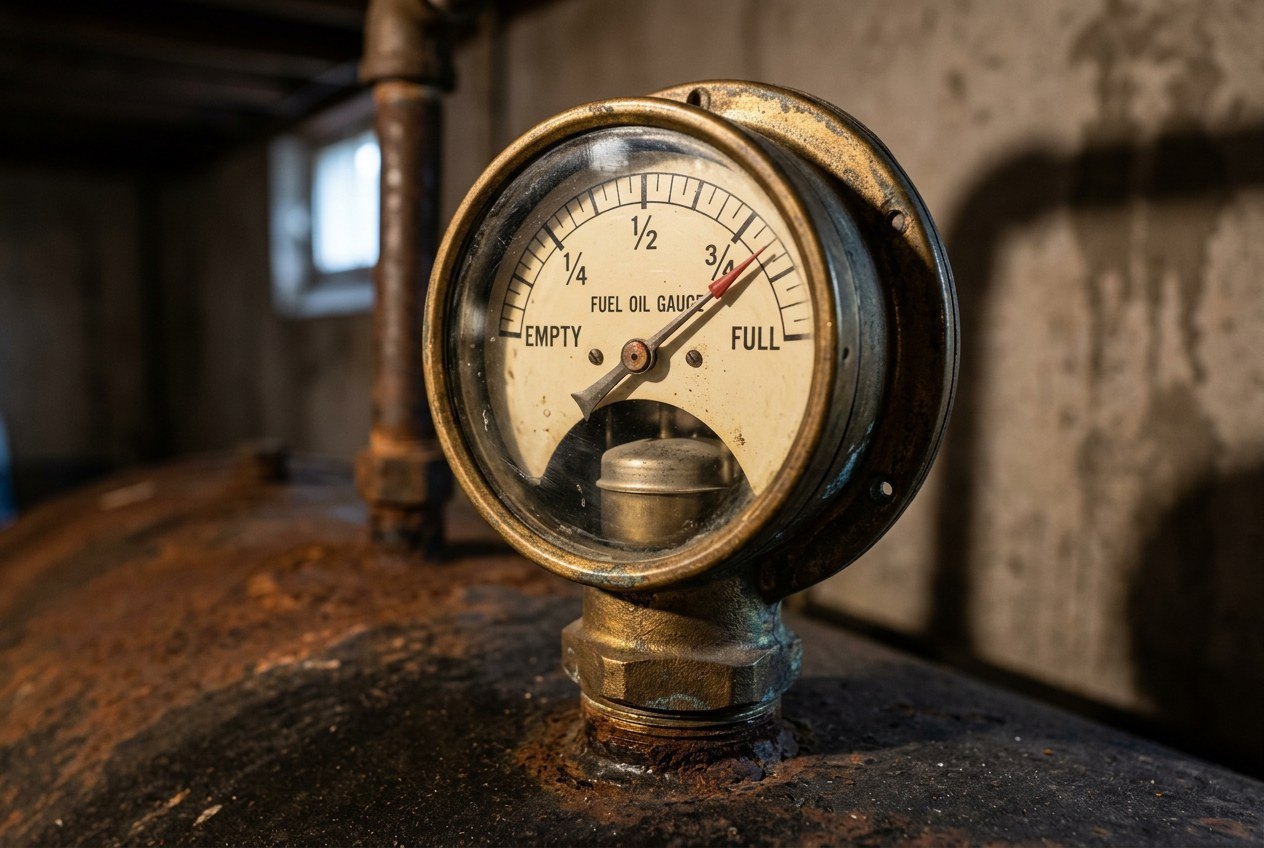
Reading your own tank gauge is easy: the float-and-dial gauge on top of most tanks shows the level as a fraction — full, three-quarters, half, quarter. Treat a quarter-tank as your signal to act, not empty.
What affects how much you use
- Weather. A brutal cold snap can burn fuel far faster than a mild week — the biggest single variable.
- Home size and insulation. A large or leaky house uses more; see winter prep for sealing tips that cut consumption.
- System efficiency. A well-tuned, high-AFUE furnace or boiler stretches every gallon further.
- Thermostat settings. Even a couple of degrees, especially overnight, adds up across a long season.
What happens if a tank runs dry
Running out is worth avoiding for reasons beyond the obvious cold. When a tank empties, the burner draws air and stirs up whatever sludge has settled at the bottom, which can clog the filter and nozzle. Restarting a system that has run dry is not always as simple as adding fuel — the lines may need bleeding of air, and the filter may need changing before the burner will fire reliably again. In the middle of a cold snap, with roads difficult and demand high, that is the last situation any homeowner wants. Treating the tank gauge as something to act on well before empty, rather than a countdown to zero, avoids the whole problem.
Planning for the season
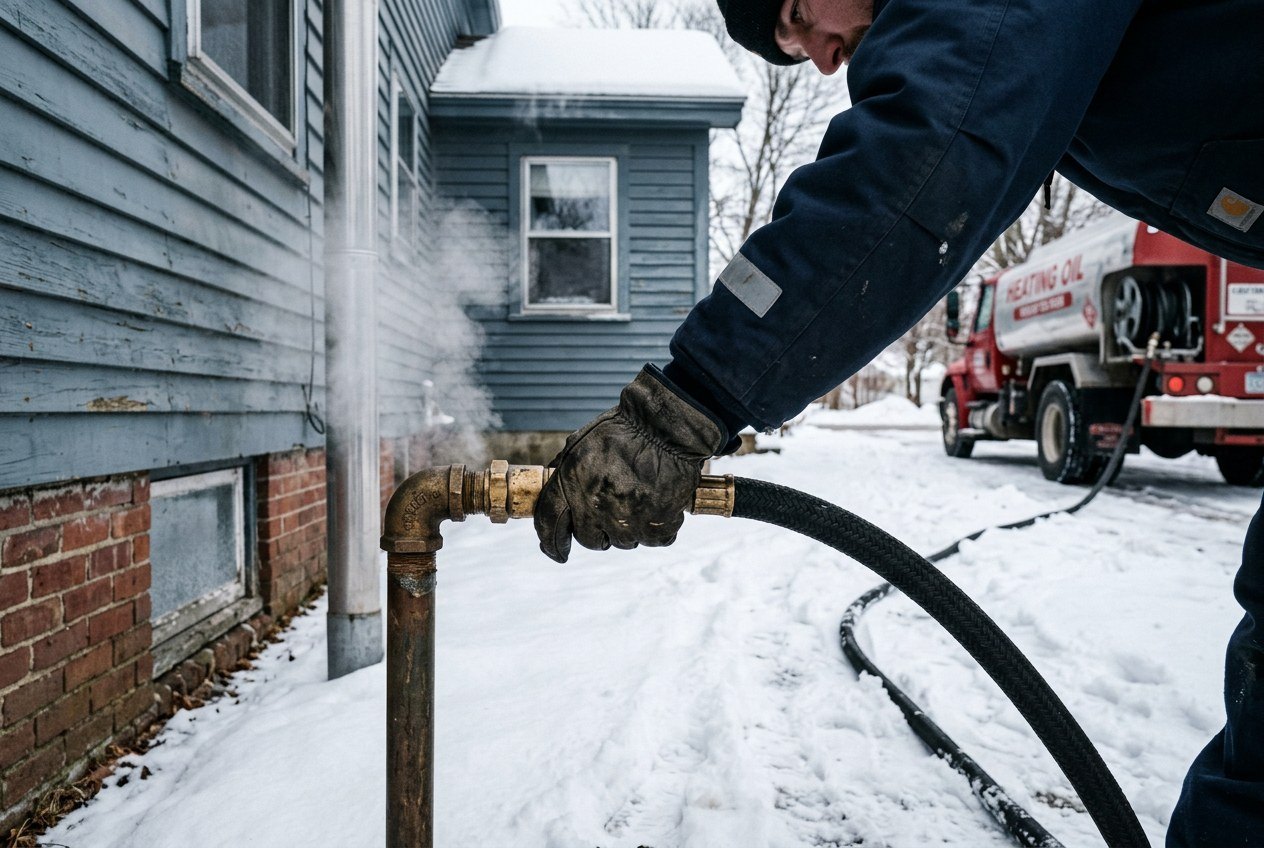
The practical goal is never to be caught short. Heading into winter with a full tank is smart on two counts: it gives you the largest possible buffer against a cold spell, and it minimizes the empty airspace where condensation forms, which helps with the water and corrosion issues covered under tank care. During the coldest months, keep a clear, shoveled path to the fill pipe so a delivery can always reach it.
However you arrange it, the aim is the same: a steady supply of clean fuel so your system — which you can read about on the heating oil basics page — always has what it needs. If you are still weighing fuels, the oil vs. propane vs. gas comparison puts on-site oil supply in context.